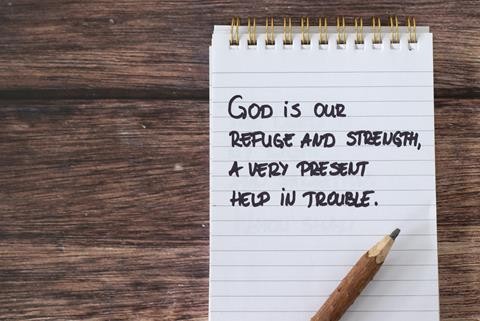
When Hearts Are Churned Up

When Hearts Are Churned Up
It goes without saying that we are living in an anxious world.
As I write this, the price of oil is moving in sympathy with conflict in the Middle East. The Strait of Hormuz is suddenly familiar to us because the fuel we need to move cars around our cities, and farm implements around our land – and the fertilizer that our farmers need to sow crops – is in danger of being choked off.
And we are anxious. That’s how anxiety works.
It presses in. It narrows the future. It makes the world feel smaller.
It can choke hope.
In the parable of the sower, Jesus says that the cares and anxieties of the age can enter in and choke the word. In other words we can stop listening to his perspective on things. Our chests tighten, our hearts race and we can feel trapped inside possibilities that have not yet happened, and may never happen.
This coming Sunday is the fifth Sunday of Easter.
Our gospel is from John 14. St John will take us back to Holy Week, to the events of Maundy Thursday, the night when Jesus was betrayed. (John 14:1-14)
On that night Jesus provides some shocks of his own for his disciples.
He washes their feet. He announces that one of them will betray him. He tells Peter that before morning Peter will deny him three times. And now, most troubling of all, Jesus tells them that he is going away.
They are stunned.
They have left everything to follow him. Nets, boats, family businesses, former lives — all of it has been left behind because of him. If he leaves them now, where will they go? What will they do? What will have been the point of it all?
Into that churned-up room Jesus speaks these stunning words:
“Do not let your hearts be troubled. Believe in God; believe also in me.”
The word translated “troubled” can mean disturbed, agitated, stirred up — even like water churned into motion.
Jesus is saying: do not let your hearts be roiled from within. Do not let fear throw you into confusion. Do not let your hearts become like troubled waters.
But Jesus is not offering trite platitudes. He’s not saying ‘there, there, she’ll be right mate!’… that would be to offer religious sentimentality from a safe distance.
Jesus is promising something much deeper.
He can do this because he truly knows what ‘trouble’ is.
In John’s Gospel, Jesus himself is troubled at the grave of Lazarus. He is troubled when he announces Judas’ betrayal.
And he is troubled as he faces the hour of his suffering and death. The fact that Jesus is the Son of God does not mean that he floats above grief, fear, betrayal, sorrow, and anguish. He enters them.
So when Jesus says, “Do not let your hearts be troubled,” he is not speaking as one untouched by trouble. He is speaking as the one who is about to enter the deepest trouble of all. He will go to the cross. He will bear sin, death, judgment, abandonment, and hell itself. He will go where we cannot go, to do what we cannot do, in order to bring us where we could never bring ourselves.
He goes to ‘all this terrible trouble’ for us – for you!
And that is why his words can be trusted.
Anxiety often lives in the imagined future: what might happen, what might be lost, what we might not be able to control.
It asks us to live tomorrow’s trouble today. It invites us to believe that everything depends on our ability to predict, manage, solve, and make secure.
Jesus answers our anxiety not by giving us control, but by giving us himself.
“In my Father’s house there are many dwelling places,” he says. “I go to prepare a place for you.”
He does not promise that the road will be free of trouble. He promises that he is the way. He does not merely point toward truth. He is the truth. He does not merely offer help for this life. He is the life.
This is the freedom faith gives.
Not freedom from every difficult circumstance. Not freedom from grief, uncertainty, hard decisions, or anxious nights. But freedom from being finally ruled by them. Freedom from the exhausting burden of having to know the future before we can live faithfully in the present.
Freedom from pretending that we are in control.
And freedom from the fear that, if our hearts are troubled, we have somehow fallen outside the care of God. That is not the case!
In these anxious times hear Jesus’ words once again – they are for you – they are for your anxious heart right now – no matter the cause.
“Trust in God.”
“Trust also in me.”
“It is finished.”
“I am making all things new!”
Christ is risen. He has gone through death and come back to us alive. And because he lives, even our anxiety is held steady in his pierced and risen hands.
“Peace I leave with you; my peace I give you. I do not give to you as the world gives. Do not let your hearts be troubled and do not be afraid.”