• Skip to primary navigation
  • Skip to main content
  • Skip to footer
  • LCA Portal
  • Login to LAMP
  • LCA Online Donations
  • IT Help
  • Contact

Victoria Tasmania District of the Lutheran Church of Australia

1201 Riversdale Road
Box Hill South VIC 3128
Phone 03 9236 1200

MENUMENU
  • HOME
  • ABOUT US
      • DISTRICT BISHOP AND STAFF
        • Bishop Lester’s Message
      • LUTHERANS IN THE VICTORIAN DISTRICT
      • DISTRICT COUNCILS AND COMMITTEES
        • District Church Council
        • District Church Council News
        • District Sponsorship Program
        • Council for Ministry Support
        • Board for Lutheran Education Victoria, New South Wales and Tasmania
      • DISTRICT-RELATED ENTITIES
        • Aged Care
        • District Campsites
        • Lutheran Men of Victoria
        • Lutheran Women of Victoria
        • This N That Community Store
  • DEPARTMENTS
          • CONGREGATIONAL SUPPORT
            • African and Migrant Mission and Ministry
            • District Prayer List
            • Worship Planning
          • HOSPITAL CHAPLAINCY
          • PASTORAL CARE TRAINING AND SUPERVISION
          • PROFESSIONAL STANDARDS
          • YOUTH AND YOUTH ADULT MINISTRY (YYAM)
          • ADMINISTRATION
            • District and LCA Policies
            • LAMP & LAMP 2
            • Planned Giving
  • NEWS AND EVENTS
    • District News
    • Coming Events
    • District Convention of Synod
    • Employment and Volunteer Opportunities
    • District Vacancy and Calls
    • Ministry Resources
    • YouTube and Social Media Connection
    • Non-Ministry Resources
    • District Communications
  • CONTACT US

Search Results for: pastor

18 August District eVoices

This edition of District eNews includes

  • a devotional message from District Pastor for Service and Witness Gordon Wegener,
  • sharing from District Pastor for Congregational Support Pr Brett Kennett,
  • a Cow!,
  • and some new initiatives from the LCA including LCANZ Christian Care Sunday.

As always Prayer Points for the next fortnight and links to LCA and departmental eNews are included

Read more HERE
Filed Under: News

Disruption and reorientation – A message from District Bishop Lester Priebbenow

Another disruption! Victorian lockdown 5.0!

I don’t know exactly what you had planned to do this week, but I imagine that what you are doing may be quite different from what you planned.

For many of you, I assume there was a mad scramble to reorientate and readjust your plans so you could continue work with some sort of semblance and order.  One can only imagine what many congregations and pastors are facing as we seek to reorientate and adjust to another major disruption.

I have you in my thoughts and prayers, not just for the practical or technical challenges you face, but for the personal sense of disruption and disorientation that also leaves pastors physically separated from their flock, and the flock from its pastor. I think of the words of last Sunday’s Gospel, where Mark said that the people were ‘like sheep without a shepherd’ (Mark 6:34). Matthew adds the words, ‘harassed and helpless’ to describe them (Matt 9:36). There is no doubt that the disruption and separation of another lockdown can leave us all feeling ‘harassed and helpless.’

Last Thursday, our District Office devotion explored a common pattern of orientation, disorientation and reorientation, which occurs when sudden, major events disrupt the expected order of things in our lives. The author recalled how Bible scholar Walther Brueggemann had observed this pattern both in the grouping of the psalms and in individual psalms.

His example was Psalm 27 which David opens with a positive orientation (verses 1-3), beginning with the words, ‘The Lord is my light and my salvation – whom shall I fear?’ David then describes the disorientation brought about by the disruptions, dangers and difficulties in his life (verses 4-12). Yet as he reflects, prays and worships his way through those disruptions, God renews his confidence amid them. There is a reorientation to the confidence with which he began the psalm, concluding with the words, ‘Wait for the Lord; be strong and take heart and wait for the Lord’ (verses 13-14).

Another favourite psalm of mine that follows this pattern is Psalm 73.

As I pray for you throughout this time of disorientation, I pray that your meditation on the greatness, goodness and grace of your God will help reorientate you to, ‘be strong and take heart and wait for the Lord’ (Psalm 27:14).

Allow yourselves to be pastored by the words of Psalm 23 that you heard – albeit electronically – on Sunday. Be reassured by the words of Ephesians 2, that we are ‘brought near’ to the hope and promises of God through the blood of Christ, ‘for he himself is our peace’ (Eph 2:14) and ‘our righteousness’ (Jer 23:6).

In His Peace,

Pastor Lester Priebbenow
District Bishop – LCA Victoria and Tasmania

[This message is adapted from a message sent to Pastors on Friday 16th July]

Filed Under: Bishop's message

28 April District eVoices

Read this week’s eVoices to find out more about District Convention of Synod including the extension of registration by one week. If your congregation hasn’t registered a delegate this is your opportunity but registrations will close 04 May.

There are several volunteer and one paid position available at the moment and you can find out more via the links.

Lutheran Women of Victoria meets this weekend in Shepparton and we pray for travelling safety and a great time of fellowship as they meet. We rejoice with the Pakenham Lakeside community as the installation of Pastor Eugene Minge approaches on the 9th of May, and also with the Benalla Wangaratta parish with Pastor Howard Beard to be installed on 16 May.

Read more HERE

Filed Under: Uncategorised

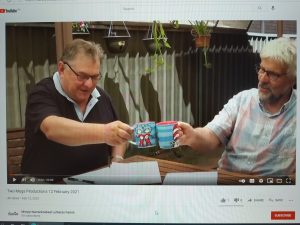
Meet the Two Mugs

Who are the Two Mugs?
We are Pastor John Weier (Warracknabeal) and Pastor Geoff Schefe (Horsham).

How did Two Mugs come about?
Pr John was to lead one of the devotional worship services at Continuing Education for Pastors (CEP) in April 2018.  Between us we decided that we wanted to ‘do something different’.  We brewed an idea to have a conversational look at the chosen text which was Psalm 42.  The positive feedback from that experience emboldened us to consider doing more messages in that style.                        We even talked about getting technical and doing some kind of recording.

Why the name, Two Mugs?
John and I are both coffee fanatics, and not just your undersized latté either, it has to be mug sized!

How long have we been doing Two Mugs?
We began very rudimentary recordings for Advent in 2018.  The first was done on John’s mobile phone in his echoey dining room.  We soon realized that we had to investigate better technology, mainly based on helpful critical reviews from several friendly, faithful friends.  So we up-scaled technology with better cameras, better microphones and better lighting.  And we got better at what we were doing, becoming much more comfortable in our overall aim, which is to bring the Word of God to people in a relaxed, conversational way.  We were even asked to give a live example of our work, leading the opening service of the LWV (Lutheran Women of Victoria) Wimmera-Mallee zone rally in 2019, discussing ‘Treasures in Clay Jars’ (2 Corinthians 4).

The COVID-19 restrictions on public worship provided an ideal avenue for us to use technology like YouTube to spread the Gospel message and remind people that church buildings were shut, but the work of The Church continues – undaunted.

Along the way we have developed such a rapport we are like brothers.  One begins a sentence or idea and the other finishes it.

The most enjoyable thing about doing Two Mugs?
We laugh – a lot – and laughter is good.  I believe we both enjoy that brotherly gift of being able to ‘bounce things off each other’ and come up with the same conclusions. We seem to think on very similar wavelengths.  And did I mention that we laugh a lot?

We have both found that our time together has proved psychologically therapeutic.  We have sometimes met up feeling a bit down but have invariably finished our planning or recording session on a high.  Oh, and we laugh a lot!

Can we, will we continue if/when my call to New Zealand becomes a reality?

Our intention is to get even more techy and continue – when and how we are able.

God is good – He will make a way.

By Pastors John Weier and Geoff Schefe – Two Mugs Productions.

Pr Geoff and Pr John doing their thing

Pr Geoff and Pr John doing their thing


You can find the most recent Two Mugs video at https://www.youtube.com/watch?v=PUNl4dtOfB8

Filed Under: News

17 February District eNews

17 February District eNews includes a message from Pastor for Congregational Support, Brett Kennett and news of events and Pastor Calls in the District plus more
Go to the District News tab to read more or subscribe at eNews (lca.org.au) to this and other eNews

Filed Under: News

LCAVD Strategy Review

Leaders from across our Vic-Tas District came together on Saturday 9 May for our annual Strategy Morning, to share and discuss their thoughts on the strategic direction for our District. Participants included representatives from the Ministry and Mission Council (MMC), Lutheran Youth Victoria (LYV), Lutheran Education Vic, NSW/ACT, Tas (LEVNT), and our Camps.

The morning began by capturing the purpose of the time together, which included:

  • Discern the Holy Spirit’s plan for us / our District
  • Clarify and confirm our work
  • Hear updates on accomplishments over the last 12 months
  • A space to encourage flexibility and ability to adapt
  • Share observations and experiences, to better understand the current state of the District
  • Understand and deepen partnerships between various groups (incl. schools, camps, youth/young adults) and the District

Informative updates were presented by Pastor Brett Kennett (Congregation Support and Acting Bishop), Sabine Haeusler (MMC), Michael Benbow (LYV), Colin Minke (LEVNT), and Stephen Mildred (District Church Council Secretary).

After a time of fellowship over morning tea, DCC Chair, Tony Vong, led the group in a review of the Vic-Tas Strategic Plan.  This plan helps to guide District Church Council on where and how to focus attention and energy in support of the ministry of the Congregations and Parishes in our District.

We thank all of the participants for the gift of their time and energies, to support the District Church Council in setting, reviewing and realising the strategic directions for the District.

Photo: Strategy Day participants.

Filed Under: Governance, homepage

EMMY so far …

Emmy so far…

So what’s EMMY?

EMMY kicked off this year at the initiative of the LCANZ’s Mission Directors.

It’s a simple, generous space for pastors and leaders to pause, listen, and reflect together on where God’s mission is already unfolding among us.

Rather than being a program or a strategy, EMMY is a monthly online conversation shaped by prayer, scripture, and lived experience. Each gathering usually begins with a short stimulus — a reflection, story, or video — followed by open conversation. The emphasis is not on having the right answers, but on learning to notice, name, and trust what God is already doing.

For many, EMMY has become a welcome counter‑rhythm to busy ministry life: a place to slow down, to be reminded that mission begins with listening, and to be encouraged by the wisdom and faith of others across districts.

Missed a few sessions? You can still take part.

If you haven’t been able to join EMMY live — or if you’ve only dipped in recently — you’re warmly invited to backtrack.

Earlier EMMY videos are now available online, making it easy to catch up at your own pace.

The videos aren’t polished productions. They’re intentionally simple and reflective, designed to be watched quietly, revisited, or shared with others.

Many people have found them helpful as:

  • a conversation starter with colleagues or leadership teams
  • a way of re‑orienting ministry around prayerful attentiveness rather than urgency

Whether you watch one or several, the invitation is the same: to slow down, listen deeply, and allow God’s mission to come into clearer focus.

If you’ve been part of EMMY already, backtracking can also be a way of re‑hearing themes that continue to echo — prayer that fuels mission, courage to move beyond maintenance, and trust in the Spirit’s quiet work among God’s people.

You’re invited to join the conversation — live when you can, and online when you need.


Explorations in Mission and MinistrY (EMMY)
Online Conversations for Pastors and Leaders – 2026

From Maintenance to Movement
Helping congregational leaders shift from survival mode to Spirit-led mission

Many congregational leaders know the feeling: there is always another issue to manage, another gap to fill, another decision to make. Energy goes into rosters, budgets, buildings, governance, and expectations. Much of this work is faithful and necessary. But over time, leadership can become almost entirely reactive. Instead of asking where God is leading, leaders find themselves focussing on keeping things running.

That is often the point where a congregation slips into maintenance mode.

Maintenance mode is not a sign of poor leadership. It is usually the result of accumulated pressure: declining capacity, ageing volunteers, financial stress, cultural change, and uncertainty about the future. In that environment, pastors, councils, and ministry leaders naturally focus on stabilising the present.

Yet leadership in the church is not only about preserving what is. It is also about helping a community listen again for the voice of God.

The shift from maintenance to movement begins when leaders recognise that their task is more than institutional care. It is spiritual discernment. It is helping a congregation lift its eyes from immediate pressures and recover a renewed imagination for mission.

That shift begins with theology before strategy.

When leaders move into ‘saviour mode’, believing that the future of the church depends on them, anxiety rises. Leadership becomes heavy. Decisions become defensive. Risk feels irresponsible. But the church belongs to Christ. Leaders are stewards, not saviours. Their role is not to rescue the church through effort alone, but to lead people in faithful response to the God who is already at work.

That truth does not make leaders passive. It frees them to lead with clarity and courage.

Leaders who help congregations move toward mission usually do several things well.

First, they name reality honestly. They do not pretend everything is fine, but neither do they allow fear to dominate. They create space for truthful conversation about fatigue, loss, and uncertainty.

Second, they keep returning the congregation to its deepest identity, its charism. The church is not simply an organisation trying to sustain itself. It is the people of God, gathered by grace and sent into the world in love.

Third, they create practices of discernment. Rather than rushing to solutions, wise leaders ask better questions: Where do we see signs of life? What is God drawing our attention to? What is one faithful next step?

Fourth, they lead toward manageable action. A new connection with the local community. A renewed commitment to hospitality. A small experiment in neighbourhood engagement. Movement rarely begins with dramatic change. More often, it starts with simple, faithful steps.

Previous Recordings

February – What on Earth is God Doing? And how do I join in?   LINK
March – Leading with Missional Imagination   LINK
April – Prayer that Fuels Mission   LINK
May – to come


Coming Up in 2026

📅 June 23 – Seeing our Neighbour with New Eyes
In this conversation, we’ll learn simple ways to “read” our local context — listening, noticing, and discerning where God’s Spirit is already active among our neighbours.

📅 July 28 – Faith the Spills Over: Everyday Discipleship in Action
Mission isn’t just for the few — it’s for all of us. This session will explore how ordinary believers can live out and speak the gospel naturally in their daily lives. Together, we’ll share ideas for helping faith overflow into everyday conversations and actions.

📅 August 25 – Better Together: Building Mission Partnerships in Your Community
You don’t have to do mission alone. Many congregations are discovering the joy of working alongside schools, service groups, and local agencies. Join us to explore practical ways to form meaningful partnerships that reflect Christ’s love in your neighbourhood.

Podcast Pick (a monthly suggestion for those who like listening to podcasts)
When Church Stops Working invites you to reflect on a deep and timely question: what does it mean when the church seems to stop working? In this inspiring 20-minute podcast, Lutheran pastor and theologian, Andrew Root explores what that can mean for the church, for ministry, and for those called to serve with faith and hope.

https://podcasts.apple.com/us/podcast/when-church-stops-working/id1462822741?i=1000571605618

https://open.spotify.com/episode/5nhnRn3QRNNyam0BioKnxO?si=fb1aee1ccf5c4484

Busy churches are not always missional churches. Movement is not about doing more. It is about aligning the life of the congregation with the heart of God. Even a small or tired church can become deeply missional when it is open to the Spirit’s leading.

The challenge for leaders is not simply to keep things going. It is to help God’s people take the next faithful step with courage, trust, and hope.

Filed Under: Congregational Support, homepage

Ash Wednesday

At our Ash Wednesday services, we hear an Old Testament reading from the prophet Joel:

“Blow the trumpet in Zion; sound the alarm on my holy mountain! … the day of the LORD is coming… a day of darkness and gloom… Yet even now, declares the LORD, return to me with all your heart… rend your hearts and not your garments. Return to the LORD your God, for he is gracious and merciful…” (Joel 2:1–2, 12–13)

That’s vivid and startling imagery from Joel – he grabs our attention with his cry of alarm, and talk of darkness, gloom, and ‘rending’ of hearts.

Ash Wednesday, and the season of Lent, are an annual reality-check for us. In the Ash Wednesday service, there is an invitation for ashes to be marked on the worshipper’s forehead as a sign of our fragility and of this world’s temporary and fragile nature. In this, God’s Word tells us the stark truth about our human condition. Yet these ashes are traced in a particular pattern—the pattern of a cross. So even as God speaks his confronting word, he also speaks his comforting word: the truth of what he has done for us in Jesus Christ. God’s rescue has come, by Jesus’ cross and resurrection. And so God’s last word to us is his grace and mercy.

This year other images were fresh in our minds on Ash Wednesday.

As we considered darkness, gloom and ash, the reality of Victoria’s recent bushfires was particularly vivid for some.

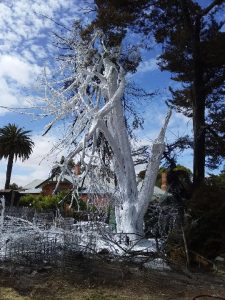
The image of a stately old tree, destroyed by fire and covered with ash, bears witness to a day when things were fragile, frightening, and temporary. This image is of an historic tree at Keith and Sally Lockwood’s property at Natimuk. Numerous homes were destroyed, including a former manse next door to the Lutheran Church.

Our prayers are still needed for those who survived and are carrying the shock – and further afield for those who lost loved ones in other parts of the state.

In a firestorm, what we thought we could rely on can ignite and become ash with terrifying speed. This is a reality check.

But Ash Wednesday is not the Church being grim for the sake of it. It is God’s kindness returning us to reality through the call to repent.

We misunderstand repentance though, if we think it is a religious self-improvement project — “I’ll try harder… so that God will be pleased with me… so that God will overlook the ‘other stuff’… so that God will see that ‘at least I’m trying!’

Each of those “so thats” is merely a bargain, a religious cloak that we drag on, an attempt to manage God on our own terms.

No, repentance is a gift. “God’s kindness leads you to repentance” says Paul in Romans 2:4.

And God delivers this gift through his Word, as he speaks to us in the two ways that our Lutheran tradition has called God’s two ‘words’: his first word that exposes and kills the lie (the law), and his last word that raises and restores us with Jesus (the gospel).

Listen to Joel again: “Return to me with all your heart… rend your hearts…” (Joel 2:12–13). God is not asking for a performance. He is after our heart—because our heart is the problem.

God’s first word names the truth that we want to avoid: the world is broken—and we are involved. The brokenness is seen in the environment’s attempts to kill us – and our attempts to kill the environment. The Bible gives us language to describe this: “the world is fallen” from where God intended it to be. St Paul says: “the whole creation has been groaning” (Romans 8:22). We see it and feel it in the fragility of things, when the “normal” conditions we assume should be with us every day suddenly disappear in a storm of ferocious fire – or when our health fails or some other unexpected suffering lands.

But, ultimately, God’s Word refuses to let us hide behind the delusion that the problem is “out there somewhere.” Because repentance calls us to recognize that the deepest crisis is not in the atmosphere, or the politics, or the stupidity of other people. The deepest crisis is in our own human heart.

Our propensity to love and trust things other than God, and our propensity towards selfishness, has destructive implications for our relationships, within families, between husbands and wives, between parents and children. Between the two sexes generally. Between Christians. Between Christian groups.

The problem of sin is not ‘out there’. The Russian novelist Aleksandr Solzhenitsyn wrote that “the line dividing good and evil cuts through the heart of every human being”. This is why the Psalmist does not pray, “Help me polish myself up,” but: “Have mercy… wash me… create in me a clean heart” (Psalm 51). He is pleading for divine action, not human effort.

And here is the good news: God has taken divine action. God does not speak his first word to you without intending that you also hear his last word.

After fire, what do we see: in time first shoots push through what has been a dead landscape. The ground is cleared, the undergrowth opened, gentle life-giving light reaches places it hasn’t reached for years. Repentance has this shape too: God clears away the dense undergrowth of self-deception and sin, and then God’s light, the light which is Jesus himself, reaches us—reaches into us, with the consoling word of forgiveness.

God’s last word is Jesus.

On Ash Wednesday the ashes speak to us of God’s first word – but the cross shape that they come in speaks to us of God’s last word. Joel puts it like this: “Return to the LORD your God, for he is gracious and merciful…”

And so, also on Ash Wednesday we hear St Paul writing with the same kind of urgency as Joel: “We implore you on behalf of Christ, be reconciled to God… now is the day of salvation” (2 Corinthians 5:20; 6:2).

And how does God reconcile you? Not by telling you to climb back up to him, but by coming down right to where you are – in his Son: “For our sake he made him to be sin who knew no sin, so that in him we might become the righteousness of God” (2 Corinthians 5:21).

And so God’s last word, the gospel, does not say to us: “Achieve.” It says: “Receive!”

God does not say: “Fix yourself,” but “Look!, behold my perfect Son, given for you.”

I saw an illustration of the divine help of the gospel back in 2009, right after another Victorian bush fire. That was the year of the cataclysmic Black Saturday bushfires. Many will remember the horrific scale of loss—lives, homes, communities, and the long shadow that followed. At the time, I was serving as pastor at Greensborough, and we had parishioners in the fire zone north of Melbourne. When Sunday morning came, the news was still unfolding. We were fearful for our members; phone calls were made, but communications were out.

One member had prepared as well as he possibly could—but in truth, he probably should have left earlier. He fought off ember attacks, but as the fire approached, his equipment failed. And in that moment, when careful preparation hit its limit, he did the only thing left to do: he got inside his home, shut the doors, and waited and prayed. He described the roar outside like a freight train. The sky went black. The air turned to grit. Heat pressed in. With nothing left to do, he could only hunker down and cry out “Lord, please save me!”

What saved him and his home was help from outside. The firefighting helicopter nicknamed, “Elvis”. Help arrived in the form of a massive, drenching deluge: thousands of litres of cleansing, quenching, cooling water hit the property.

Hearing him tell the story, I couldn’t help but be reminded of our baptism — in that fire, my parishioner was ‘buried’ in saving water. St Paul teaches us: “Don’t you know that all of us who were baptized into Christ Jesus were baptized into his death? … we were buried with him… in order that… we too may live a new life” (Romans 6:3–4).

My parishioner was the recipient of a reality check that day. He discovered what he could not do. He also discovered the difference between self-salvation and rescue.

We are led into repentance when we realise all of our “so that” strategies are useless, when our old self hits the end of its resources.

And then, God meets us with grace from outside ourselves. Christ’s death and resurrection deliver to us, again, the needed rescue.

So, each Ash Wednesday when ashes say, “You are dust, and to dust you shall return,” the cross says the deeper thing: you are not abandoned dust. You are dust claimed by Christ — washed, forgiven, and made new. Dust with new life breathed into it.

God’s last word to you is not “try harder.” God’s last word is Jesus: crucified, risen, and given for you.

Return to the Lord, yes. But hear what that really means: return to the One who has already returned to you.

In the name of Jesus! Amen.

Filed Under: devotions, homepage

Growing in Gospel Fluency

I recently had the joy of leading an in-person Gospel Fluency workshop with members of the Nunawading and Waverley Lutheran Church. The workshop was well attended with enthusiastic participants, and appreciation expressed for the course content. It ran from 10:00 am to 1:30 pm with a lunch break in the middle.

Please contact me if you would like an in-person workshop at your congregation. This is the second one run in the district this year and more are planned next year. It’s even possible for congregations to ‘self-run’ the course using the course materials provided!

You can find out more about the workshop, which has been developed by our own Pastor Nathan Hedt with assistance from Jo Chamberlain – here: https://www.lca.org.au/gospel-fluency

One of the great strengths of this workshop is the way it helps us move past the fear that is often associated with “traditional” evangelism.

Gospel Fluency is not about techniques, pressure, or “imported” programmatic approaches that feel artificial. Instead, it focuses on helping everyday Christians learn to speak the good news of Jesus naturally – within the relationships and rhythms that we already have.

The website introduces the workshop with a set of honest and disarming questions:

Do you ever feel awkward, ill-equipped, unqualified or unprepared to share the gospel?
Do you know someone who is curious about Jesus or the Christian faith, but you’re not sure what to do next?
Do you wish you could share the gospel more freely and naturally with family, friends, workmates, or neighbours?

If you answered yes, then Gospel Fluency is for you. The key idea is right there in the name: fluency. Like learning any new language, fluency requires vocabulary, context, and practice. You try new words. You learn by “having a go”. You give yourself permission to make mistakes, because that is how people actually learn.

We also explored practical tools to help us think through the why, who, what, and when in relation to sharing the gospel in more detail.

Throughout the morning there was a strong sense of:

  • encouragement, rather than pressure,
  • discovery, rather than performance,
  • participation, rather than passivity,
  • and, above all, trust in the Holy Spirit’s work.

And that’s good news for us as Lutherans. The mission is God’s mission. We are joining the work that God is already doing. Our part is to stay prayerful, attentive, and ready to “give the reason for the hope that we have” – with gentleness and respect.

You don’t need to go far to put gospel fluency into practice. God has already placed you among people who trust you. Start there. Pray for opportunities. Listen well. And as God opens the way, speak the good news of Jesus – simply, naturally, and confidently.

Filed Under: Congregational Support

‘Lutherans Live! Online Church’

Announcing a new initiative! – ‘Lutherans Live! Online Church’

In response to requests for support from LCA members, the LCA Vic-Tas District is preparing to host an online Worship and pastoral gathering for those feeling unsettled or adrift.

The gathering will be designed to provide pastoral support to people in situations where they find it hard to get support from a pastor, worship together with others, or find a community, and to create a space to listen, pray, and walk together.

Our plan is to gather online and join the Sunday morning Bendigo Lutheran Church livestream. This will be followed by online fellowship conversation, led by Pr. Gordon Wegener.

We will offer a safe and confidential space where you can share – if you wish – or simply be present and receive encouragement.

Our hope is to offer comfort and fellowship, and support you pastorally.

You are warmly invited to express interest in joining with us and get further information by contacting Trudi.

Filed Under: Congregational Support

« Previous Page
Next Page »

Footer

Lutheran Church of Australia

Contact Us

1201 Riversdale Road
Box Hill South VIC 3128
Phone 03 9236 1200
Email us

Copyright © 2026 · LCA Districts Theme on Genesis Framework · WordPress · Log in