• Skip to primary navigation
  • Skip to main content
  • Skip to footer
  • LCA Portal
  • Login to LAMP
  • LCA Online Donations
  • IT Help
  • Contact

Victoria Tasmania District of the Lutheran Church of Australia

1201 Riversdale Road
Box Hill South VIC 3128
Phone 03 9236 1200

MENUMENU
  • HOME
  • ABOUT US
      • DISTRICT BISHOP AND STAFF
        • Bishop Lester’s Message
      • LUTHERANS IN THE VICTORIAN DISTRICT
      • DISTRICT COUNCILS AND COMMITTEES
        • District Church Council
        • District Church Council News
        • District Sponsorship Program
        • Council for Ministry Support
        • Board for Lutheran Education Victoria, New South Wales and Tasmania
      • DISTRICT-RELATED ENTITIES
        • Aged Care
        • District Campsites
        • Lutheran Men of Victoria
        • Lutheran Women of Victoria
        • This N That Community Store
  • DEPARTMENTS
          • CONGREGATIONAL SUPPORT
            • African and Migrant Mission and Ministry
            • District Prayer List
            • Worship Planning
          • HOSPITAL CHAPLAINCY
          • PASTORAL CARE TRAINING AND SUPERVISION
          • PROFESSIONAL STANDARDS
          • YOUTH AND YOUTH ADULT MINISTRY (YYAM)
          • ADMINISTRATION
            • District and LCA Policies
            • LAMP & LAMP 2
            • Planned Giving
  • NEWS AND EVENTS
    • District News
    • Coming Events
    • District Convention of Synod
    • Employment and Volunteer Opportunities
    • District Vacancy and Calls
    • Ministry Resources
    • YouTube and Social Media Connection
    • Non-Ministry Resources
    • District Communications
  • CONTACT US

Search Results for: church

District Church Council meets with East Metro leadership

On Saturday 6th August, District Church Council and 24 leaders from Eastern Zone Lutheran congregations and parishes met at Good Shepherd Ringwood, to hear from each other about their congregation’s:

  • Blessings
  • Challenges; and
  • Opportunities

As often happens at these annual District Church Council visits across the District, some have the same challenges, and others have often experienced or experimented with solutions to just that issue. So, it is unsurprising that there were lots of enthusiastic questions and discussions. Interestingly participants were keen to share contact details so they could follow up shared interests and activity in the future.

Chair of District Church Council David Bergmann said it was wonderful to hear first-hand from congregations & parish leaders from:

Greensborough, Outer Eastern, Doncaster-Ivanhoe, St Paul’s Box Hill, Chinese Lutheran Church, Nunawading-Waverley, Ringwood-Knox, Moorabbin-Dandenong, Gippsland Parish, Bethlehem Rosebud, and Pakenham Lakeside Church.

District Administrator Stephen Mildred
Filed Under: News

Unity: Elusive but a Blessing

Lately I’ve been thinking quite a lot about the matter of unity. The theme for our upcoming General Convention of Synod, “The Gift of God – It’s Grace that Unites us” calls us to contemplate the unity of the church in the face of theological differences.

Unity is also a current topic politically. After an assassination attempt on former US president Donald Trump, national leaders past and present made public appeals for unity, one of them urging people to consider that, ‘we have much more in common than what divides us.’

Unity is a common theme in the ‘objects of the church’ according to our constitutions. The church commits to ‘unite in one body… promote and maintain true Christian unity in the bond of peace… ensure that preaching, teaching and practice in the Church are in conformity with the Confession of the Church… cultivate uniformity in worship, ecclesiastical practice and customs in accord with the principles laid down in Article X. of the Formula of Concord’ (LCA Constitution 3.1). Our church constitutions require bishops ‘to strive for unity, harmony and good order in the Church’. For Lutherans, unity is always based on a common confession of faith in ‘the divinely inspired, written, and inerrant Word of God, … as the only infallible source and norm for all matters of faith, doctrine, and life’.

Better Together in Christ

The author of a devotion entitled, ‘Better Together in Christ’ reflected on the gift of unity in the body of Christ, focussing on Psalm 133: ‘How good and pleasant it is when God’s people live together in unity… Harmony is as refreshing as the dew from Mount Hermon.’  She then described unity as something that ‘may feel elusive’. [Patricia Raybon, Our Daily Bread, July 14, 2024].

Why is Unity Elusive?

This begs the question about why unity ‘may feel elusive’. What things threaten unity among God’s people? In Scripture, James asks the same question, ‘What causes fights and quarrels among you?’ He immediately answers his own question, saying, ‘Don’t they come from your desires that battle within you? You want something but don’t get it…’ (James 4:1-2). Unity between brothers and sisters in Christ is threatened when we give free reign to our selfish desires at the expense of our concern for others.

The unity of the church is also threatened by false teaching. St Paul appeals to Christians in Rome ‘to watch out for those who cause divisions and create obstacles contrary to the doctrine that you have been taught; keep away from them’ (Romans16:17). When he tells pastor Timothy to ‘command certain men not to teach false doctrines any longer,’ he says that ‘the goal of this command is love, which comes from a pure heart and a good conscience and a sincere faith’ (1 Tim 1:1-3). The Word of God is the basis for Christian unity and for that reason it can also be the cause of division. Martin Luther wrote, ‘The Word and doctrine will create Christian unity or fellowship. Where they reign, all else will follow. Where they are not, no concord will ever abide’ (Sermons from the year 1531. WA 34/2:387).

What Promotes Unity among God’s People?

Many New Testament passages urge God’s people to strive for unity in the body of Christ. From them we learn that true unity is found most of all in an attitude of humility, both under God’s Word and before one another. According to St Paul, ‘Speaking the truth’ of God’s Word, but doing so ‘in love’ promotes unity and maturity in the body of Christ (Ephesians 4:14-16).

I read recently how in any disagreement, ‘both positions are subject to their own forms of corruption by sinful humanity’. So, the desire for unity requires constant searching of the Scriptures, self-examination, repentant hearts, and lots of humility from all concerned. For example, it may be easy for me to issue a call for unity, but I must search my motives by asking, ‘Is the unity I desire on God’s terms or my own terms? Is the appeal for unity based on a result that is to my liking, in that unity will exist when the other person yields to my desire?’

Christian unity is never something that can be forced or demanded. Unity is the ‘fruit of the [Holy] Spirit’ at work in our hearts through the Word of God. That is why the apostles urge us to ‘live by the Spirit and not to gratify the desires of our sinful natures’,  to let ‘the fruit of the Spirit’ triumph over ‘the acts of the sinful nature’ (Gal 5:16-26), to ‘let the Word of Christ dwell among us richly and let the peace of Christ rule in our hearts’ (Col 3:12-15), to ‘submit ourselves to God’  and ‘to one another out of reverence for Christ’ (James 4:7; Eph 5:21), and to ‘make every effort to maintain the unity of the Spirit in the bond of peace’ (Eph 4:1-6).

Unity as a Gift and a Task

It is often said in the context of ecumenical relations that unity is both a gift and a task. The gift is that there is One Holy Christian Church which is the fellowship of faith and of the Holy Spirit in people’s hearts. The task is to seek and maintain outward unity through the right use of Word and Sacrament. Scripture would suggest that this principle also applies within church bodies as Christians put the gift of their unity in Christ to work in the task of living in Christ-like love toward one another. St Paul writes, ‘Therefore if you have any encouragement from being united with Christ, if any comfort from his love, if any common sharing in the Spirit, if any tenderness and compassion [the gift], then make my joy complete by being like-minded, having the same love, being one in spirit and of one mind’ [the task] (Philippians 2:1-2).  ‘As God’s people, chosen and dearly loved’ [the gift] we are urged, ‘clothe yourselves with compassion, kindness, humility, gentleness and patience’ [the task] (Col 3:12-15).

A Practical Application

How may all this be applied? Unity in the body of Christ does not mean that we agree on everything, but that differences can and should be discussed in light of God’s Word and godly solutions sought for the good of the body as a whole. 1 Corinthians 8:9-13 and Romans 14:1-23 are examples of how the Biblical principles of humility, servanthood and love were applied to a situation in the early church. Some, whose consciences were not troubled by eating meat offered to idols refrained from doing so for the sake of their brothers and sisters in Christ whose consciences would have been troubled by doing so.  The Jerusalem conference of Acts 15 is another example where these principles were applied to a church dispute.

In the LCA documents of union, the uniting synods echo a strong sense of eagerness to maintain the unity of the Spirit in the bond of peace. Yet even they acknowledge the elusive nature of unity, the inevitability of broken fellowship with other churches because of differences in doctrine, and the possibility of separation where there is persistence in error that is damaging to the cause of the gospel (DU 6; TA 1:4a).

Encouragement

My musings here are by no means comprehensive, but I leave them with you to consider. Just as the devotion I mentioned earlier reminded us that unity ‘may feel elusive’, it also said that unity is ‘a beautiful goal for believers’ and ‘it blesses all’. According to Psalm 133, ‘When God’s people live together in unity… there the Lord bestows his blessing, even life evermore’ (Psalm 133:3). My prayer is that each of us may consider how we may live in Christ-like humility, both under God’s Word and before one another, so that God may bless his church with true unity.

O Comforter of priceless worth,
grant one mind to your flock on earth;
support us in our final strife,
and lead us out of death to life.
                     LH 197 v.3 Martin Luther 1483-1546.
tr. Catherine Winkworth 1827-78 (1863) alt.

Filed Under: Bishop's message, devotions

St Paul’s Box Hill – ​​​​​​​Dedication of New Buildings


For some years, St Paul’s Lutheran Church in Box Hill watched as the area around them was sold and redeveloped at a great pace into a sea of towers and high density living. Mission seemed exciting but access to their church, which they had built in 1953-54, was becoming difficult, and parking almost impossible especially during the week. They pursued several options but then came a ‘God-moment’ for them – St James Uniting Church at 1201 Riversdale Road was for sale, and the site included a carpark over the road. The purchase was finalised in October 2018, after a very successful sale of their property in Box Hill.

It then became a project of love to restore this church for their current needs because it had a heritage overlay, due to its notable early modernist, mid-century architecture designed by the prominent architect David Chancellor of Chancellor & Patrick. The exterior of the church needed to be retained in its entirety – but an exemption was granted by Whitehorse Council for the front entry. The interior was extensively renovated and it is now an inspiring and beautiful worship home which will serve the congregation well for many years ahead. The church was re-dedicated in 2020.

However, the rest of the buildings on the site were unsuitable for the needs of St Paul’s congregation, and for the two other entities who wished to join St Paul’s on the same site. They are the Chinese Lutheran Church, formerly meeting at Doncaster, and the head offices of the Lutheran Church of Australia, Victorian and Tasmania District. And so St Paul’s Centre was born, with planning for the extension commencing soon after purchase. This was interrupted during the Covid years and an explosion in building costs. The congregation engaged the same architectural firm they had used for the church renovation, Law Architects, and they have done fine work in extending the church space into large community and office areas – all the time preserving the integrity of the original church design including its façade.

During August, the congregations will move all their activities and staff into the centre, with the District following in November.  It will be formally dedicated on 14 September, but members are already enjoying the space and warmth of their new home.

Do feel free to visit us and inspect our new premises, and enjoy some hospitality. God’s goodness and grace to us needs to be shared!

Filed Under: community

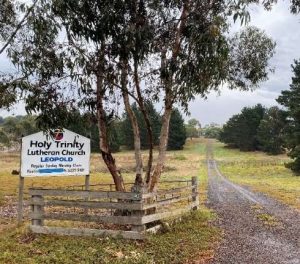
Closure of Holy Trinity, Leopold

J. Paech, secretary of St Johns Geelong Lutheran Congregation, at the opening of the Leopold Chapel in 1976, noted that, “The Spirit of the Lord is undeniable. It is only through His mercy and grace that this church has managed to continue and grow. ”

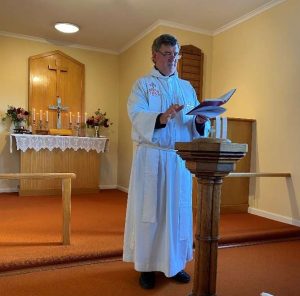
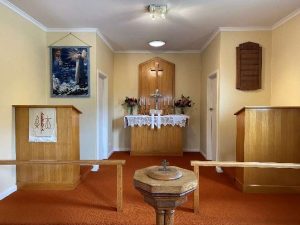
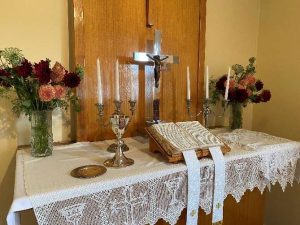
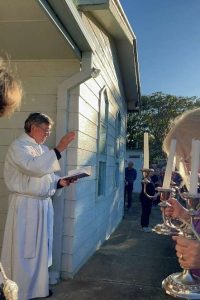
On 22nd October 2023, the members of Holy Trinity celebrated the 50th Anniversary, which recalled much history in the Lord’s mercy and grace. Now, eighteen months later on 27 April 2025, we came together to observe the Rite of Closure. There may be sadness and a sense of loss in closing this consecrated place of worship. Yet it is with thanks that we acknowledge the Lord’s mercy and grace in the work of the founding members, and life of the Congregation.

We look back to learn, to gain endurance and encouragement, so that we can look forward with unity and hope. Our celebration honours God encourages hearts and fosters belonging. When we celebrate the past, it is easier to believe in a bright future. There has been so much life and ministry happening over five decades. The most important thing you can do is lean on prayer and scripture.

The Old Testament records many festivals and holidays. When the church celebrates together, life is more fun. Do not underestimate the value of fun in the health of the church. In January 2025, we joined the Living Faith Lutheran Church Greater Geelong, together with St Davids Freshwater Creek, St Johns Geelong and St Pauls Grovedale. We take the memories that we hold, along with a new vision of the future. We have new energy for our ministry, new enthusiasm for what the church can accomplish. Celebrations help to bring out the gold and the gifts in the members as they offer their best to the Lord and His people.

Today we thank Pastor Boyd for leading the Closing Rite for this church building. We thank the Pastors throughout the years that have encouraged us in the faith here. We fondly remember Pastor Fritch who passed from this life on 8 February 2023. We recognise and celebrate the lives of people who are making, or have made, an impact on our lives. We acknowledge R. Pearce, J Pohl, J Paech, L. Hepner, E. Schultz, R. Bothe, S. Cioch, I Stasinowsky.


Our association with St Johns has always been there. Records show some of the ways they helped with their skills and talents. For example, a St Johns member audited our Treasurer’s books for us. Since 2014, when our treasurer asked for assistance with the Telco Towers, a St Johns member has helped us, also helping with land sales, etc. We are deeply indebted to him for his mentoring and commitment, using his God given skills. We have so many people to thank who have helped in various capacities over the years. We have also benefited from St Johns musicians and Lay Readers; Holy Trinity and St Johns have both been blessed with many resourceful members.

The old quarterly minutes and documents give us a walk down memory lane. They record a wonderful, accomplished group of Holy Trinity and St Johns members using their God-given talents to help each other throughout the years. What a blessing on our doorstep! This celebration is enriched by recognising that where we are now, is the fruit of St Johns ministry, which God worked through them and their investment of time and resources.

Thank you to both congregations for 50 years of friendship.

Scripture has lots of verses about worship, prayers, relationship, etc. It does not say much about closing a church. Thats because God sees church differently than we often do; we might focus on the beginning and end of a legal entity or a building, however, Jesus said, “I will build My church, and the gates of HELL will not prevail against it.” The church, as the Body of Christ, will never fade away, it will never be defeated.

Let us pray:

Lord grant us the wisdom to make decisions that honour You and benefit our community.
Help us to live with integrity, humility and compassion, reflecting Your everlasting love in all our actions.
May the power of Your Holy Spirit guide us in our work and cause us to listen to Your voice in every decision we make.
We ask for Your blessing in our efforts and that Your spirit will empower us to fulfill our responsibilities with grace and strength.
In Jesus’ name, we pray.
Amen

We acknowledge and celebrate the ministry of Living Faith Leopold worshipping centre that is coming to a close. We close the church building with integrity and hope.

A walk down memory lane…

Photos supplied by Leopold Congregation.

Filed Under: community

Eulogy for Pastor Milton Fritsch

Milton Andrew Fritsch was born in the Temora Hospital on August 8th, 1961, and grew up on the family farm as the eldest son and child of Elmore and Ruth Fritsch. Born into a Lutheran household, Milton was baptised on August 20, 1961, at St John’s Evangelical Lutheran Church and confirmed on September 21, 1975, at Trinity Lutheran Church, Temora.
Milton. A name he didn’t love much as a child until his father assured him it was chosen because it was a “grown up name”, and that’s why it suited him. As a young lad, Milton spent his days on the farm helping with jobs, playing with his brothers and sister, and establishing some of his lifelong passions including nature, rugby, and the state of New South Wales.
Speaking of lifelong, as a very young boy, Milton struck up a friendship with his neighbour Robert Wiencke. The two of them of them would often walk to school together, and nearly three decades later, Robert would be standing next to Milton once again as the best man on his wedding day. Truly a friendship that went the distance.
School life presented its challenges for Milton growing up. Country New South Wales in the 60s and 70s struggled to offer the kind of curriculum that matched his interests. However, despite not finding his place at school, Milton was determined to live out his adolescent dream of joining the Australian Navy. But God had other plans, and after two failed attempts at being recruited, that dream slipped away.
Milton left his beloved Temora at age 19 to work as a banker at several branches across regional New South Wales. Throughout his 20s, he went from the towns of Young to Goulburn to Cooma, playing at their local rugby clubs and climbing whatever mountains he could find. There are two seminal moments during this period of Milton’s life. The first was during the early 80s when, while watching an episode of Countdown, Milton first listened to the music of British new-wave heavy metal band Iron Maiden – an experience that would literally shape his musical taste for the rest of his life.
The second was later in the decade, when Milton felt called to leave behind his career as a banker and become a pastor in the Lutheran church. He had already spent much of his adult life working in youth ministry, all the while maintaining a close connection to his personal faith. So, after consulting his parents who were both incredibly affirming of this pathway, Milton uprooted his life, moved to Adelaide, and started seminary in 1989.
As Milton would often tell his mum, he only had two priorities during those early years of study: passing Hebrew, and “hitting the line at pace” as a winger for the North Adelaide Rugby Club. He was successful at both, although his sporting triumphs were somewhat dampened – or perhaps further mythologised – by a string of dislocated shoulders that would continue to haunt him long after he hung up the boots.
Between passing classes and scoring tries, Milton, or “Fritschy” as he was known amongst his cohort, would enjoy a few quiet drinks at the “Welly” pub in North Adelaide. It was here where Milton met a young, spirited speech therapist student called Gaylea Schirmer. A young, spirited speech therapist student who, much to Milton’s surprise, started showing up at his rugby matches to watch him play. Week after week after week.
In his wisdom, Milton read this situation from the only logical point of view that made sense to him: Gaylea clearly shared his passion for the mighty game of rugby. Thankfully, Gaylea’s patience lasted just long enough for common sense to finally hit Milton, and the two began a love story for the ages. On February 15, 1992 – yes, the day after Valentine’s Day – Milton asked Gaylea to marry him, and the two made their wedding vows at Grace Lutheran Church in Ipswich on December 19 of that same year. Milton upheld those vows with honour and dignity for the rest of his life, and his love for his beautiful wife and closest friend remained strong each and every day across 30 years of marriage.
Milton graduated from his Bachelor of Theology in 1992, before embarking on a vicarage the next year at Good Shepherd Lutheran Church under Pastor Mike Hassold. Pastor Mike, who was also recently called home to Jesus, taught Milton a lot about preaching the Word of the Lord and ministering to a congregation of people, and acted as a mentor figure throughout the rest of Milton’s career as a pastor. Graduating with a Diploma of Ministry in 1994, Milton was ordained on January 8, 1995, at St Paul’s Lutheran Church in Toowoomba where he made his faithful vows to serve his Lord and his parishes with love and grace.
Milton and Gaylea moved to Emerald in early 1995, where he was installed in his first parish. Ministering in central Queensland meant Milton would drive upwards of 300kms on Sundays as he went from congregation to congregation preaching the gospel and connecting with people. It was during these early days of his ministry where Milton discovered his uncomplicated approach to serving the Lord. He was humble, he was steadfast, and he had the ability to always find the best in people from all walks of life. He boiled it down to “love Jesus, love each other” and that basic, beautiful world view was the guiding light he never wavered from.
Emerald was where Milton and Gaylea started to grow their little family. First came a beautiful daughter, Maria Elizabeth Fritsch, who was born on July 17, 1996. Two years later, on October 19, 1998, they had their son, Harry Milton Fritsch. Despite already being in his mid-30s and working full time, Milton took to fatherhood instantly, and loved nothing more than teaching, nurturing, and spending quality time with his children.
In May 1999, Milton and Gaylea made the brave decision to pack up their two little ones and accept a call at St John’s Lutheran Church in Kingaroy. Those two little ones soon became three, after Abigail Ruth Fritsch was born on October 1, 2001. Milton and Gaylea’s little family was now complete.
In Kingaroy, Milton strengthened his leadership qualities, introduced contemporary worship, and had the wonderful opportunity of ministering to a school. But family life remained his top priority. Whether he was taking the kids on a lap around the backyard on the motorbike or going on a family day trip to the Bunya mountains, his young family was happy and settled living where they were.
And yet, as is often the case with these things, God had other plans for Milton, Gaylea, and the kids. In January 2005, Milton accepted a call to Mountainside Lutheran Church in Auckland, New Zealand. Moving a young family to an entirely different country, away from all their established support networks, was a massive undertaking for Milton and Gaylea. However, it was worth all the stress, as Milton relished working at Mountainside – especially in his cross-cultural and church planting ministries. He was also honoured to be elected as the Vice President of the New Zealand district during his time there.
Milton and the family also adored exploring every inch of New Zealand while living there. Milton never shied away from his love of mountains and could name the height of any given peak in both metres and feet at the drop of a hat. New Zealand allowed him to witness some of the world’s most stunning mountains in person – none of which captured his imagination or unwavering attention more than Aoraki/Mt Cook. For those wondering, its elevation is 3,724 metres or 12,218 feet.
After spending seven beautiful years in Auckland, Milton and the family felt the need to return to Australia to be closer to his elderly dad. He accepted a call to Ipswich Lutheran Parish where he faithfully served and navigated the excitement and challenges of ministering to three separate congregations. While at Ipswich, Milton had the pleasure of living close to his parents where he could provide the support and care they needed during some difficult times. His children were also fast growing up, with Maria and Harry graduating from high school and university, and Abigail progressing through her school years. He took immense pride in their growth, and always championed the direction they wished to take their lives.
In early 2017, Milton received a call to St John’s Lutheran Church in Geelong. While he originally gave little thought to the opportunity, God planted a seed in his heart that quickly grew into a genuine commitment to serve the people of this parish. However, moving to Geelong would mean having to split up his family. While this decision brought about plenty of heartache, Milton, Gaylea, and the kids kept the faith that their distance would have no impact on their close bond, and they have not weakened in the years since.
Milton was installed at Geelong in late 2017, and he intended to serve his remaining years as a pastor in this parish. He took great joy in mentoring Pastor James Ruei and the blossoming South Sundanese community within this church family. He loved ministering to the school and building meaningful connections with people from across the city. He had found a true home and a sense of belonging that spoke to all the years of work that had led to this calling.
Geelong was also where Milton and Gaylea witnessed their children begin their own careers and start their own families. Despite having to work through a pandemic, his dedication to his family and his congregation remained as powerful as ever, and he loved planning what adventures the future years may hold with his wife, his children, and their partners.
Sadly, Milton did not get to experience all those adventures. At least, not in this lifetime. On the morning of February 8, 2023, Milton passed away due to complications following knee surgery. He was 61 years old. After dedicating a lifetime of service, he was called home to be spend eternity in the loving arms of his Lord Jesus Christ.
He was pre-deceased by his father Elmore, who passed away on January 29, 2022. He is survived by his wife Gaylea, his children Maria, Harry, and Abigail and their partners Peter and Virag, his mother Ruth, his siblings Robin, Simon, Jason and their families, his parents-in-law Alwin and Val, and his siblings-in-law Richard, Lenka, Kate, Jim and their families.
Milton was too many extraordinary things to describe in one eulogy. He was Pastor Milton, husband, dad, uncle, brother, son, Fritschy. He was a cheeky grin and a full beard. He was a hopeless nerd for all things Batman, Thor, Mad Max, and Dirty Harry. He was barbeques on Saturday morning and “spag bols” on Sunday nights. He was a motorcycle and navy enthusiast through and through. He was a lifetime supporter of the Wallabies, New South Wales Blues, Manly Sea Eagles, and the North Melbourne Kangaroos. He was test cricket in the summer and warm fires in the winter. He was a glass of red wine and a steak medium well-done with a Diane sauce. He was the first to celebrate someone else’s achievements, and the last to leave a conversation. He was an endlessly patient, loving, and faithful pastor, family man, and friend to so, so many people.
But if we could use one, single word to encapsulate everything that Milton was, is, and will always be, it would be this:
He was brilliant.

Filed Under: general news

Riding the Waves conference

The IRC conference speakers provided hugely valuable insights, and encouragement, for those of us navigating change – and that’s pretty much all of us!

The day was a wonderful opportunity for more than 60 attendees to receive and reflect on missional approaches from many different perspectives. Although originally planned as a fully in-person event, one of the presenters tested positive for COVID and one could not travel from the UK because of a COVID diagnosis, and so they gave presentations on Zoom – a perfect illustration of the waves of change that all of us have faced in the last two and a half years! The presenters took us through a post-war history of the mission of the church in Australia; New Testament approaches to spiritual formation; assessing whether your local church is ready for change, and the dynamics of the change process in local churches. Read more from Pr Nathan Hedt’s article HERE

Below are some ‘take aways’ and links to resources from Vic District attendees:

“The great first century religions ‘of wood and stone and marble’ are extinct (think Rome and its great temples). The only two religions who have survived are the religions ‘of the book’, Christianity and Judaism. And you wouldn’t have bet on either of them in the first century!”

“Christianity does not save me from suffering – it gives my suffering new meaning”

“The primary task of the church is spiritual formation. We are rediscovering this. The Holy Spirit is working, through the church, to spiritually form us into the image of Christ. This is also known as discipleship formation. Spiritual formation is: a life-long process, a communal process, a thoughtful process. It’s a thoughtful process because God renews our minds as we read his word. Congregations do well when they focus on a few regular habits or practices that are communal, thoughtful and focussed on God’s word. God uses suffering and persecution to bring about spiritual formation.”

“COVID was not a snow storm, it ushered in a new ice-age and has given God’s church a chance to ‘tell it like it is’”

“Historically the church stuck around when plagues hit (unlike the pagan Roman elites who ran away from opportunities to be infected). And plagues hit regularly. Historians estimate that christian numbers increased by one third after major plagues. “How can we serve our neighbours best in a time of plague?”

“Let’s not waste a good crisis.”

(shared by Pastor for Congregational Support, Pr Brett Kennett)

A couple quotes stood out for me (both by Ian Robinson):

  1. “Whatever happened to the grasp Jesus had on us?” –  referring to the way evangelism has all but disappeared from church agendas, and the fact that most church members rarely read their Bibles.
  2. “The church we are saving cannot be the one we have had.” – referring to the tendency, in challenging times, to want to return to what we have known rather than to seek to be the church we need to be in those challenging times.

(shared by District Bishop Lester Priebbenow)

My highlight was participating in a physical identification of our context as a part of exploring “ Theory U” from work by Otto Scharmer. The Rev’d Canon Dr Nigel Rooms asked us to position ourselves as a representation of where our Congregation/denomination was at in terms of working through the reality of our context as Church in a Post-modern world adapting to Change. It was interesting hearing from those at different points in the “U” in regards how it felt to be at that place in the journey.
About Theory U 

IRC Open Day conference on 29th June 2022 : now available for viewing. Four videos, one for each speaker from the conference, on the New and Renewing Churches website: www.newandrenewingchurches.org.au/events

(shared by Congregational and Migrant Ministry Support Officer Erin Grainger)

Filed Under: Uncategorised

EMMY so far …

Emmy so far…

So what’s EMMY?

EMMY kicked off this year at the initiative of the LCANZ’s Mission Directors.

It’s a simple, generous space for pastors and leaders to pause, listen, and reflect together on where God’s mission is already unfolding among us.

Rather than being a program or a strategy, EMMY is a monthly online conversation shaped by prayer, scripture, and lived experience. Each gathering usually begins with a short stimulus — a reflection, story, or video — followed by open conversation. The emphasis is not on having the right answers, but on learning to notice, name, and trust what God is already doing.

For many, EMMY has become a welcome counter‑rhythm to busy ministry life: a place to slow down, to be reminded that mission begins with listening, and to be encouraged by the wisdom and faith of others across districts.

Missed a few sessions? You can still take part.

If you haven’t been able to join EMMY live — or if you’ve only dipped in recently — you’re warmly invited to backtrack.

Earlier EMMY videos are now available online, making it easy to catch up at your own pace.

The videos aren’t polished productions. They’re intentionally simple and reflective, designed to be watched quietly, revisited, or shared with others.

Many people have found them helpful as:

  • a conversation starter with colleagues or leadership teams
  • a way of re‑orienting ministry around prayerful attentiveness rather than urgency

Whether you watch one or several, the invitation is the same: to slow down, listen deeply, and allow God’s mission to come into clearer focus.

If you’ve been part of EMMY already, backtracking can also be a way of re‑hearing themes that continue to echo — prayer that fuels mission, courage to move beyond maintenance, and trust in the Spirit’s quiet work among God’s people.

You’re invited to join the conversation — live when you can, and online when you need.


Explorations in Mission and MinistrY (EMMY)
Online Conversations for Pastors and Leaders – 2026

From Maintenance to Movement
Helping congregational leaders shift from survival mode to Spirit-led mission

Many congregational leaders know the feeling: there is always another issue to manage, another gap to fill, another decision to make. Energy goes into rosters, budgets, buildings, governance, and expectations. Much of this work is faithful and necessary. But over time, leadership can become almost entirely reactive. Instead of asking where God is leading, leaders find themselves focussing on keeping things running.

That is often the point where a congregation slips into maintenance mode.

Maintenance mode is not a sign of poor leadership. It is usually the result of accumulated pressure: declining capacity, ageing volunteers, financial stress, cultural change, and uncertainty about the future. In that environment, pastors, councils, and ministry leaders naturally focus on stabilising the present.

Yet leadership in the church is not only about preserving what is. It is also about helping a community listen again for the voice of God.

The shift from maintenance to movement begins when leaders recognise that their task is more than institutional care. It is spiritual discernment. It is helping a congregation lift its eyes from immediate pressures and recover a renewed imagination for mission.

That shift begins with theology before strategy.

When leaders move into ‘saviour mode’, believing that the future of the church depends on them, anxiety rises. Leadership becomes heavy. Decisions become defensive. Risk feels irresponsible. But the church belongs to Christ. Leaders are stewards, not saviours. Their role is not to rescue the church through effort alone, but to lead people in faithful response to the God who is already at work.

That truth does not make leaders passive. It frees them to lead with clarity and courage.

Leaders who help congregations move toward mission usually do several things well.

First, they name reality honestly. They do not pretend everything is fine, but neither do they allow fear to dominate. They create space for truthful conversation about fatigue, loss, and uncertainty.

Second, they keep returning the congregation to its deepest identity, its charism. The church is not simply an organisation trying to sustain itself. It is the people of God, gathered by grace and sent into the world in love.

Third, they create practices of discernment. Rather than rushing to solutions, wise leaders ask better questions: Where do we see signs of life? What is God drawing our attention to? What is one faithful next step?

Fourth, they lead toward manageable action. A new connection with the local community. A renewed commitment to hospitality. A small experiment in neighbourhood engagement. Movement rarely begins with dramatic change. More often, it starts with simple, faithful steps.

Previous Recordings

February – What on Earth is God Doing? And how do I join in?   LINK
March – Leading with Missional Imagination   LINK
April – Prayer that Fuels Mission   LINK
May – to come


Coming Up in 2026

📅 June 23 – Seeing our Neighbour with New Eyes
In this conversation, we’ll learn simple ways to “read” our local context — listening, noticing, and discerning where God’s Spirit is already active among our neighbours.

📅 July 28 – Faith the Spills Over: Everyday Discipleship in Action
Mission isn’t just for the few — it’s for all of us. This session will explore how ordinary believers can live out and speak the gospel naturally in their daily lives. Together, we’ll share ideas for helping faith overflow into everyday conversations and actions.

📅 August 25 – Better Together: Building Mission Partnerships in Your Community
You don’t have to do mission alone. Many congregations are discovering the joy of working alongside schools, service groups, and local agencies. Join us to explore practical ways to form meaningful partnerships that reflect Christ’s love in your neighbourhood.

Podcast Pick (a monthly suggestion for those who like listening to podcasts)
When Church Stops Working invites you to reflect on a deep and timely question: what does it mean when the church seems to stop working? In this inspiring 20-minute podcast, Lutheran pastor and theologian, Andrew Root explores what that can mean for the church, for ministry, and for those called to serve with faith and hope.

https://podcasts.apple.com/us/podcast/when-church-stops-working/id1462822741?i=1000571605618

https://open.spotify.com/episode/5nhnRn3QRNNyam0BioKnxO?si=fb1aee1ccf5c4484

Busy churches are not always missional churches. Movement is not about doing more. It is about aligning the life of the congregation with the heart of God. Even a small or tired church can become deeply missional when it is open to the Spirit’s leading.

The challenge for leaders is not simply to keep things going. It is to help God’s people take the next faithful step with courage, trust, and hope.

Filed Under: Congregational Support, homepage

St John’s Minyip – 150 Years

150 Years since the Dedication of the first Church Building, and the Naming of the Congregation, on 25 September 1875

During 1875, a wooden structure was built on land some 6km south-west of Minyip in the area called Kirchheim, which translates as “church home”. At the dedication service of that first church building, on 25 September 1875, the congregation received its name: St. John’s. The congregation was approximately 70 to 80 communicant members drawn from 25 to 30 families. A day school, also established in 1875, was nearby.

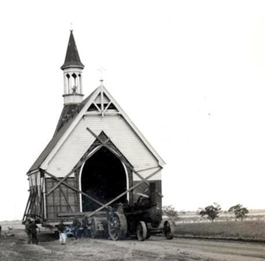
Both the first church building and school were destroyed by a storm on 26 February 1889. The congregation immediately started planning for a rebuild, with the school ready for use on 20 June 1889 and, on 4 December 1889, the new church building was dedicated. The church weighing approximately 50 tons was moved on a jinker, pulled by a steam traction engine across the paddocks to its present location in Church Street, Minyip, in May 1935. In 1936 the school closed.

On 12 October 2025 a congregation of approximately 130 people joyfully celebrated the anniversary event with a traditional church service with Holy Communion and a mostly sung liturgy, followed by an unbelievably large spread of delicious finger food.

Pastor John Weier presided, with Pastor Lester Priebbenow, Victorian/Tasmanian District Bishop, preaching the sermon on 1 Peter 2, where the ‘Cornerstone’ and the ‘living stones’ are not physical stones or a physical building but people – Jesus, us, and all Christians, who together are built into a spiritual house that has no use-by date.

Special guests included: Pastor Steen Olsen and Ruth, Pastor Denis Grosser, descendants of Pastor Dr  J. Darsow (served Minyip 1922 – 1948), Jonathan and Julie Krause representing ALWS, Mark and Jason from The Leadlight Gallery who re-furbished our stained-glass windows, and Pastor Geoff and Chris Kuchel.  Our Visitors book’s most popular comment praised the Service!!

Many stories of bygone years were exchanged, including those from previous members who recalled not only their own times but those of their grandparents and even great grandparents.


Moving St Paul’s church into Minyip, May 1935. (Photo courtesy Minyip Historical Society.)


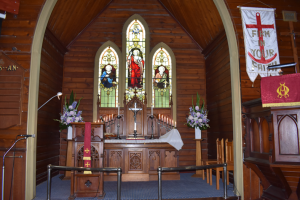
Interior of church, showing the recently refurbished stained glass windows, originally installed in 1911.


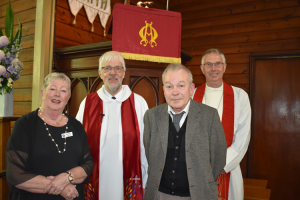
L to R: Congregation Chair Bronwyn Krause, Pastor John Weier, Organist Steven Thomas and Bishop Lester Priebbenow.


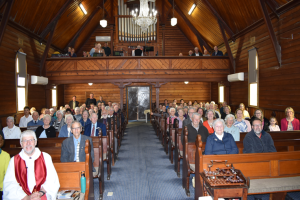
The worshipping congregation.

Filed Under: community

Investing in Leadership and Congregational Vitality

Two of our pastors, Rev. Wayne Muschamp and Rev. Nathan Hedt, have recently undertaken significant training to strengthen ministry across the Victoria–Tasmania District—both supported through the District’s Ministry and Mission Council.

Pastor Wayne has completed a year-long Church Consultancy Course focused on church vitality, mission planning, and healthy congregational life, and is now offering consultancies to congregations seeking renewal, growth, or guidance through transition.

Pastor Nathan has completed the Arrow Leadership Coach Mastery Course, gaining accreditation as a Christian leadership coach with the International Coaching Federation (ICF), and is now offering ministry coaching to pastors, church planters, and ministry teams to help them clarify vision, build resilience, and lead with greater effectiveness.

We celebrate their dedication and the way their new skills are already enriching ministry across the District. If your congregation or ministry team would like to explore church consultancy or coaching support—or learn how similar training might benefit your context—please don’t hesitate to reach out for more information. Pastors who are considering undertaking focused professional development in these or related areas are also warmly encouraged to contact me, Wayne, or Nathan to discuss opportunities for support and training.

Here’s some more detail about how Wayne and/or Nathan might be able to assist your congregation.

Since his retirement nearly three years ago, Pastor Wayne Muschamp, has been busy supporting congregations during vacancies and when pastors have been on rest and recreation leave.  It has been an opportunity to learn about Lutheran members further afield from where he last served at Nunawading and Glen Waverley.

In addition, he has undertaken a year-long church consultancy course conducted by Rev Dr Ian Dunkum, with six other people, two of whom are also Lutherans.  The principal area covered is church vitality and growth, helping congregations implement outreach into the community and see new people coming to Christ.  But developing a mission plan and vision for a church is only the preliminary stage – it is the actual implementation that is the critical factor.

Consultancy is not restricted to thinking of creative ideas to engage with people, but also to develop a healthy response to conflict and to prevent conflict, develop staff and volunteers and effective teamwork, undertake congregational and pastoral reviews, deal with trauma and abuse in a congregation and the path to recovery, develop plans for a transitional ministry, understanding leadership, governance and management, thinking about the elements of a strategic plan, how to arrive at God’s vision for a particular place, burnout and self-care, and personal spiritual formation.

Pastor Wayne says, ‘I have a real passion for evangelism and to see congregations flourish, but I also know how hard it is to chart a new course and adopt an outward focus.  Often, congregations get stuck and don’t know how to go about generating some ideas for change.  It is where a consultancy can really help.  While some suggestions and direction can come from a consultancy, most of the thinking, planning and actions come from the inspiration of Holy Spirit at work amongst his people.  My only regret about the course is that I wish I had done this forty years ago!’

The District has paid for Pr Wayne to undertake this training and he has committed himself to not charge for a consultancy but only request that expenses be covered.  Please email the District office for Pr Wayne’s contact number.


Pastor Nathan Hedt, Pastor at Luther College, Croydon, and church planter with the Ignite community based at Luther, has been sponsored by the District’s Ministry and Mission Council to undertake the Arrow Leadership Coach Mastery Course.

The course provides advanced professional coaching training, mentoring, and supervised practice, leading to accreditation with the International Coaching Federation (ICF).

Coaching is an intentional, gospel-shaped conversation that empowers pastors and leaders to grow in self-awareness, clarify priorities, and take purposeful action in their ministries.

Nathan explains, “Coaching helps people listen to the Holy Spirit, discover their next faithful steps, and live out their calling with greater focus and joy. I’ve seen firsthand how coaching strengthens pastors, planters, and ministry leaders, helping them flourish personally and lead more effectively in their local context.”

Nathan brings coaching experience from his previous role as Pastor for New and Renewing Churches, where he saw coaching significantly enhance the health and effectiveness of new ministries. Research supports what experience shows: ministry coaching is one of the most powerful tools for increasing both leadership effectiveness and congregational vitality.

Through his training with Arrow Leadership, Nathan is now offering Christian coaching to pastors, congregations, ministry teams, church planters, and leaders across the Victoria–Tasmania District. Coaching conversations can focus on areas such as:

  • Clarifying vision and priorities in ministry
  • Developing leadership teams
  • Navigating change and transition
  • Growing personal and spiritual resilience
  • Cultivating missional focus

Nathan says, “My hope is that many leaders in our District can experience the support, encouragement and growth in effective ministry that coaching brings. Having an accredited Lutheran coach available locally is a real gift to our shared mission.”

Pastor Nathan is currently serving part-time at Luther College, and volunteering part of his time in tentmaker ministry with the Ignite church plant emerging from the College community. As part of his financial support for this ministry, Nathan offers paid ministry coaching sessions.

As an expression of gratitude for the District’s sponsorship of his coaching training, he is pleased to offer coaching sessions at a reduced cost to pastors, leaders, and entities of the District. For further information or to explore coaching, please email Nathan.

Filed Under: Congregational Support

Hope Rising

Serving our Neighbour with the Hope that we have in Jesus.

New research reveals both challenges and extraordinary opportunities for the Church to share the hope of Christ

In a season when many Australians are struggling with uncertainty, new research from NCLS and Tearfund Australia, presented at a recent Webinar that I attended, reveals an extraordinary opportunity for Christians to shine as beacons of hope. While the 2025 Australian Community Survey shows concerning trends, it also unveils the transformative power of faith-based hope and points to clear pathways for the Church to serve our neighbours with the gift of hope.

Faith: The Ultimate Hope Multiplier

The most encouraging finding from the research is unmistakable: a fruit of faith is hope. Religious and spiritual Australians consistently show significantly higher levels of hope than those without faith. Prayer, worship, and Christian community don’t just provide comfort – they act as powerful “hope boosters” that equip believers to face uncertainty with confidence.

“Hope is not naive optimism,” explained Emma Wyndham-Chalmers from Tearfund Australia. “It’s courageous action, together, grounded in faith.”

This aligns with Scripture’s teaching that our hope is not wishful thinking, but confidence rooted in God’s promises.

Hebrews 10:23 encourages us to “hold unswervingly to the hope we profess, for he who promised is faithful.”

What is that hope?

1 Peter 1:3-4 – “In his great mercy he has given us new birth into a living hope through the resurrection of Jesus Christ from the dead, and into an inheritance that can never perish, spoil or fade.”

A Gift We Can Give

While only 19% of Australians feel hopeful about the world’s future (down from 24% in 2024), this might present the Church with its greatest evangelistic opportunity in years.

When the world grows dark, the light of Christ shines brightest. The research reveals that Australians are hungry for what God has given us – authentic, action-oriented hope.

There’s also something called the proximity effect – where hope increases closer to home (44% hopeful about personal futures, 32% about local communities) – which shows exactly where churches are uniquely positioned to make an impact.

Through local ministry, community service, and authentic relationships, your congregation can demonstrate the reality of Christian hope.

Living Proof: Hope in Action

Rev Adam from St Hilary’s Anglican Church in Melbourne exemplifies this hope in action. When fire destroyed part of their building, neighbours – including non-churchgoers – rallied to help, recognising the church’s positive community presence. Their community shed project and local outreach ministry, “St Hilary’s Hope,” create tangible expressions of hope that draw people in.

“Our global partnerships allow us to feel connected to big challenges that might otherwise feel overwhelming,” Adam shared. “Knowing we’re contributing—even in small ways—makes us more hopeful than simply watching the news.”

The Collective Hope Advantage

Perhaps the most encouraging finding is that 7 in 10 Australians believe that together, people can make the world a better place. This reveals a deep hunger for a gift that God can give through his church: transformative community acts of service rooted in divine purpose, inspired by hope.

Survey data is telling us that while individuals may doubt their personal impact, they maintain strong belief in collective power. The Church, with its 2,000-year history of community transformation, is perfectly positioned to channel this collective hope through the power of the Gospel.

Practical Hope Practices

The research identified key hope-building practices that align beautifully with Christian discipleship:

  • Spiritual disciplines: prayer, worship, gratitude (already central to Christian life)
  • Community connection: fellowship and mutual support (the heart of church community)
  • Purposeful service: meaningful work and volunteering (our calling to serve)
  • Healthy relationships: the fruit of Christian love in action

These aren’t merely self-help strategies – they’re biblical practices that naturally build hope while drawing others toward Christ.

Our Hope-Filled Calling

The research confirms what Scripture has always taught: hope flourishes in community, grows through service, and is sustained by faith in God’s promises. As Dr Ruth Powell concluded, quoting N.T. Wright: “What you do in the present – preaching, teaching, caring for the needy, loving your neighbour – will last into God’s future.”

While the world struggles with anxiety about war, economic uncertainty, and climate change, Christians possess the answer: hope anchored in the eternal God who works all things for good. Our calling is not to retreat from these challenges but to engage them with confidence, knowing that our labour in the Lord is not in vain.

The research shows that Australians are ready to hear about hope. They believe in collective action. They hunger for community. They long for purpose. The Church has all of these – and the good news that transforms everything.

This is our moment to demonstrate that Christian hope is not merely optimism about outcomes, but confidence in God’s character and commitment to His people. When we practice hope together through worship, service, and community, we become living invitations to the hope that never disappoints.

“May the God of hope fill you with all joy and peace in believing, so that by the power of the Holy Spirit you may abound in hope.” – Romans 15:13

For more information about the Global Hope Project and resources for your church, visit Tearfund Australia’s website: https://www.tearfund.org.au/

Tearfund Australia has developed resources specifically for churches:

  • Global Hope Report: comprehensive research analysis
  • Practising Hope: essays and reflections for personal and group study
  • Hope Conversation Guide: tools for starting hope conversations in your community


Filed Under: Congregational Support

« Previous Page
Next Page »

Footer

Lutheran Church of Australia

Contact Us

1201 Riversdale Road
Box Hill South VIC 3128
Phone 03 9236 1200
Email us

Copyright © 2026 · LCA Districts Theme on Genesis Framework · WordPress · Log in